OPSCTR is the platform that powers that work — spanning identity, tenancy, workflows, messaging, playbooks, feeds, entity-linked context, integrations, AI routing, and administrative control. INSTOPCO shapes that baseline into a disciplined operating model for the client and environment in front of it.
Feed ingestion, entity-linked context, and analyst workflow
Secure rooms, messaging, and tenant-aware administration
Workflow design, approval gates, and governed playbooks
Integrations, AI routing, TAK awareness, and connectors
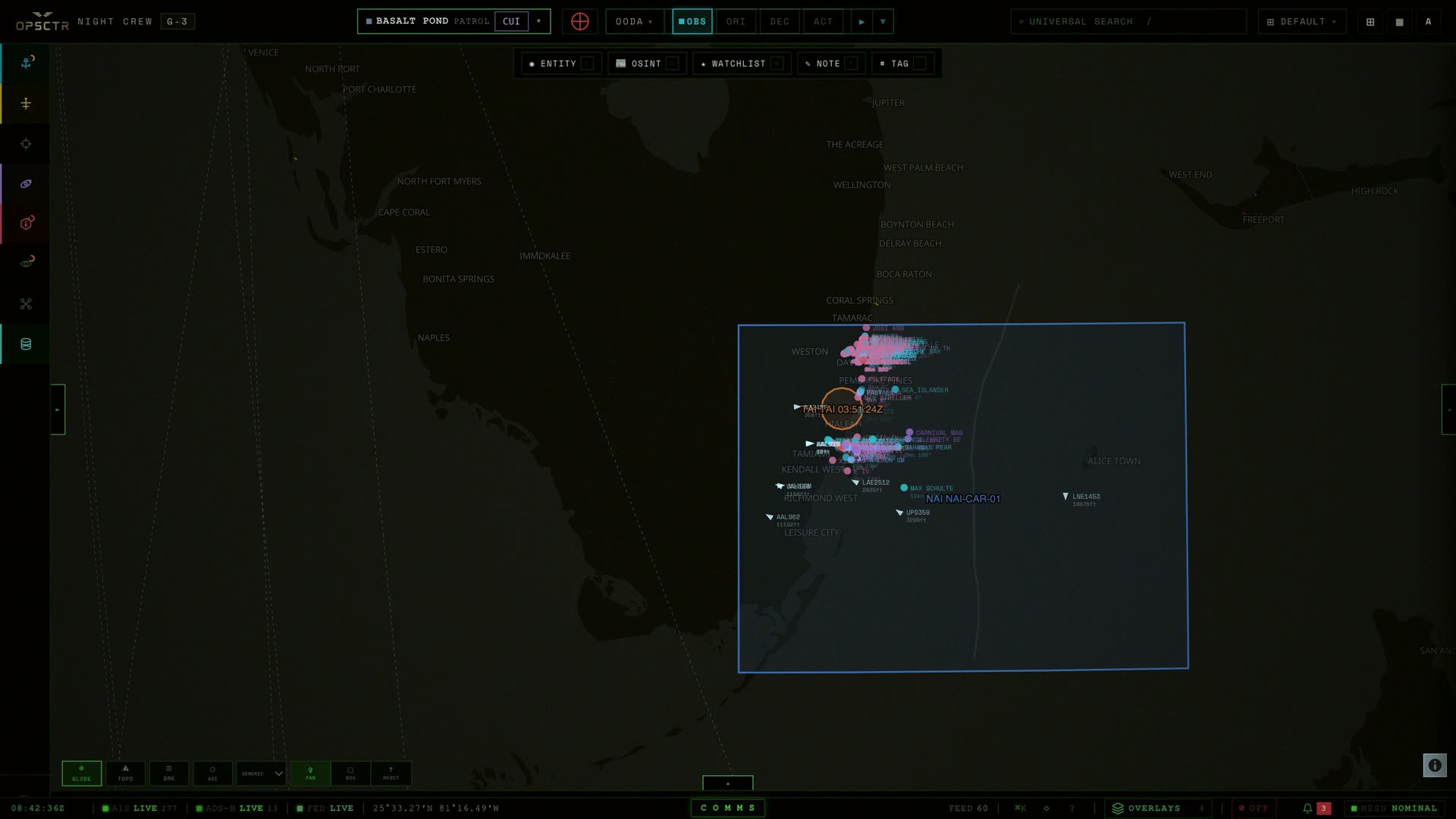
Live entity view compositing air, maritime, and ground tracks in a unified command display.
Multi-layer entity tracks across domains
Operator-selectable region and zoom
OSINT intelligence rail at bottom of view
Air tracks, maritime vessels, and ground-based air defense envelopes composited in one view.
Air, sea, and ground layers toggled live
GBAD coverage and engagement zone rings
Every entity correlated to the OSINT rail
ADS-B air tracks, AIS vessels, and US/allied base overlays with an open signal-intercept panel.
OSINT items classified HIGH / MED / LOW
Signal intercepts surface without leaving map
Base overlays anchor strategic geography
Visual workflow builder with live schema validation before the playbook runs.
AIS gap → coverage → threshold → action
Typed nodes: sources, entities, logic, actions
Schema errors surfaced inline at build time
Operational Intelligence
OPSCTR spans feed ingestion, filtering, analyst workflow, entity-linked context, and picture assembly so dispersed signals become decision-ready context rather than background noise.
Governed Execution
Workflow design, execution control, approval gates, playbooks, and state history allow intent to move through accountable operational process — not just a viewing surface.
Administrative Control
Identity, role control, tenancy, administrative settings, and operator management give the environment the discipline serious missions and enterprises require.
Federated Extension
Integration surfaces, provider routing, TAK-aware posture, and connector expansion make OPSCTR a connective operational substrate instead of an isolated application.
The GOV and NON-GOV routes separate more than tone. Each track interprets the same confirmed OPSCTR baseline through a different operational lens. INSTOPCO explains how that baseline is refined for a specific client profile rather than sold as a static package.
A government-facing interpretation for organizations that need secure coordination, governed workflows, infrastructure awareness, and doctrine-aligned execution.
How INSTOPCO shapes it
INSTOPCO maps OPSCTR into specific approval chains, mission workflows, interoperability boundaries, infrastructure controls, and escalation paths for a command, agency, or program office.
A sector-facing interpretation for organizations that need operational visibility, governed procedures, tenant-aware administration, and connected execution without losing control.
How INSTOPCO shapes it
INSTOPCO specializes the platform for logistics, industrial operations, critical infrastructure, or multi-site enterprise environments by changing roles, playbooks, integrations, and operating picture priorities.
OPSCTR provides the real feature base. INSTOPCO decides how that base should be organized, constrained, extended, and introduced for the operational conditions of a target client or sector.
The solution authority. Interprets mission or sector conditions, defines implementation posture, and refines the platform into a client-specific operating model.
The system substrate. Combines identity controls, tenancy, workflow execution, playbooks, messaging, feed intelligence, entity handling, integrations, and administrative controls.
A deployable operational environment where intelligence, coordination, approvals, and action pathways are arranged around the realities of a specific client or sector.
Confirmed platform scope
Confirmed baseline
Identity and access, multi-tenant administration, billing, feed intelligence, entity records, secure messaging, workflows, playbooks, integrations, TAK awareness, and admin control form the verified baseline.
Areas requiring discipline
Connector registry and targeting are meaningful but partial. Some historic entity-visualization capabilities are staged for re-validation before production use.
Why this matters
OPSCTR is already broad. INSTOPCO's role is to operationalize that breadth — deciding which areas should be hardened, extended, constrained, or staged for a given client profile.
INSTOPCO decides how to translate the platform baseline into a credible system for a specific environment: what must be hardened first, which workflows deserve formal gating, where integrations should be opened or restricted, and which areas should be expanded for the client in question.
INSTOPCO can map OPSCTR into specific approval chains, mission workflows, interoperability boundaries, infrastructure controls, and escalation paths for a command, agency, or program office.
INSTOPCO can adapt the same platform foundation for logistics coordination, industrial operations, critical infrastructure, or multi-site enterprise environments by changing roles, playbooks, integrations, and operating picture priorities.